Sympathy Gifts · The Loss of a Husband

A sympathy gift for someone who has lost their husband

An original tribute to him, written from what you know about the two of them and typeset beside his photograph, framed for the room she actually sits in. You approve every word before you pay.

What this loss is like

Grief that is daily and domestic


Losing a husband isn’t a person missing from the family. It’s a person missing from the room. The bed is the wrong size. The coffee is the wrong amount. There is nobody to tell the boring half of the day to, and the boring half of the day turns out to be most of it.

Widows often say the mail is its own small cruelty. Letters keep coming with his name on them for the better part of a year, from companies that don’t know, and every one has to be dealt with by the person least able to deal with it.

The friendships change too. Couples are couples, and the invitations that used to be automatic become deliberate, which everyone can feel and nobody says.

A lot of the time she is holding steady on purpose. Her children are grieving their father, and somebody in the family has to be the one who is all right. That is exhausting in a way that doesn’t show, and it is part of why something arriving from outside the family lands the way it does.

Who usually gives one

Her friends, nearly always


Most tributes to a husband are bought by the people around the widow rather than by the widow. Two or three friends going in together is the common version. Her sister is the next. Her adult children give them as well, usually from all of them at once, with the grandchildren’s names on the card.

She will very rarely commission one herself in the first year. Spending money on him feels strange to people, and choosing a photograph of him is a whole afternoon she may not have in her. Somebody else doing the deciding is most of the gift.

We make these for widowers too, and for men who lost husbands. The questions barely change. The pronouns on this page just follow who tends to be doing the buying.

How gifting works, start to finish →

Where the memories come from when you can’t ask her

Nobody should hand a woman in her second month a list of questions about her husband. That is the obvious worry with this gift, and it has a straightforward answer.

You know more than you think. You sat at their table. You’ve heard how they met perhaps forty times, and you can probably do her version of it in her voice. You know what he was like when the two of them were arguing about the route, or the thermostat, or whose turn it was to call the plumber.

Her adult children are the other source, and they are usually glad to be asked. It gives them something to do with their hands. The eulogy is worth having as well, since somebody already sat down and wrote the man out in detail, and it’s full of usable material.

If you do want to ask her something, ask one question rather than twenty. What did he always call you. What was he like at six in the morning. Most widows will talk for an hour off a question like that and be glad somebody asked, because the alternative is a world where everybody has stopped saying his name.

The proof is your safety net. Nothing prints until you approve it, so if you’re unsure whether a line is right, send the proof to one of her children and let them read it first. People do that with us regularly, and it is never a problem.

Which photograph

The wedding portrait is the obvious choice and often the wrong one. She has been looking at that photograph for fifty years, and it shows a man she can barely connect to the one she just lost.

Use the one she keeps out. On the fridge, on the hall table, him laughing at something off camera in a kitchen that has since been remodeled twice. Pick the face she talks to.
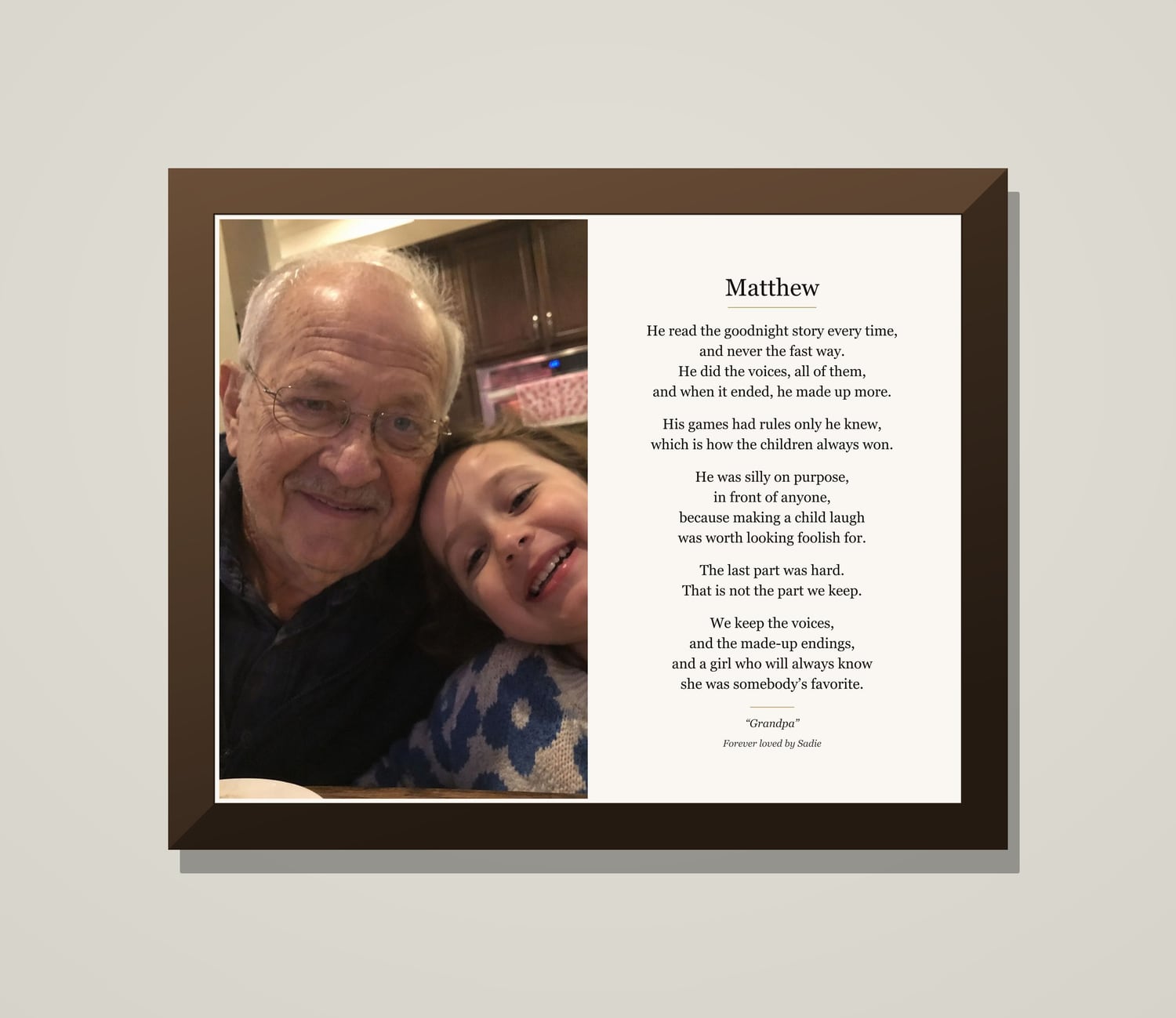
A tribute written for a widow

A sample piece for an invented couple, commissioned by two of her friends. They gave us the coffee, the toolbox, and a green chair by the window.

He made the coffee at ten past six
because she liked it waiting, not brewing.

Fifty-one years, and he still walked
on the traffic side of the sidewalk.
Still called from the hardware store
to ask whether she needed anything,
when they both knew he was only calling.

He wrote her name inside the toolbox lid.
He remembered every birthday,
including the ones on his side of the family.
He fell asleep in the green chair by nine
with the crossword half done and the pen still capped.

The house is quiet now at ten past six.
It is also still warm, and that was his doing,
and she was the reason he bothered.
A sample tribute to a husband, written for his wife by two of her friends

None of these details would fit another marriage, which is the test we hold every piece to. Yours comes from theirs.

More about how the writing is done →

When to send it

Not in the first fortnight. The house is full then. Children staying in their old rooms, neighbours at the door, more food than one person could eat in a season. Anything that arrives gets set down on a table with the cards.

The hard part starts when they all go home. Week three, week four, when the evenings arrive with nothing in them and the phone has gone back to normal. Six to eight weeks after the funeral is where this gift does the most good.

Her wedding anniversary is now the worst date on the calendar. For many widows it is harder than the anniversary of his death, because it belonged to the two of them and nothing has replaced it. If you’re aiming for it, have the piece arrive a few days beforehand rather than on the day, so she isn’t signing for a delivery and opening it while somebody watches her face.

Which is the other thing worth saying. Give her a private way to open it. Leave it at the house, or send it, rather than handing it across a table at lunch.

Allow roughly two weeks from the moment you approve the proof.

What to write on the note card

Take out “let me know if you need anything”. She won’t. Nobody does. Put a specific offer with a day attached instead. I’ll come Thursday around six with dinner. You don’t have to be dressed and we don’t have to talk.

Use his name. Ask a widow what she misses after him and a surprising number say it is hearing other people say his name out loud.

Then one thing you remember, ideally something she wasn’t there for. Ted talked me through a transmission over the phone at eleven at night and pretended he wasn’t in bed. She has his stories from inside the marriage. She doesn’t have yours.

If you’re a couple, sign both first names rather than a surname. Four lines is enough for the whole card.

Leave out the new chapter, and being strong, and what he would have wanted for her. She knows what he would have wanted. She is not able to do it this month, and being told about it is its own small weight.

When it is too personal

This one has a clearer line than most sympathy gifts, so we’ll say it plainly. A framed portrait of a woman’s late husband, given by somebody who only knows her from work, is a gift at the wrong distance. It asks her to hang something chosen by a person who never sat at their table, and it puts her in the position of having to be grateful about the most private thing in her life.

The people who give this well are her close friends, her sister, her children, the couple they went on holiday with for twenty years, the neighbour who has known him since the fence went in.

From an office, send a card with his name in it, or dinner, or cover something so she can take another week. If the workplace knew him properly and still wants to give one, keep it to the smallest size and let the colleague who is genuinely her friend be the one to bring it over.

Her children giving it to her is a different case entirely, and one of the few times the gift can arrive early. It comes from inside the loss rather than from outside it.

What actually arrives

An original tribute to him, typeset beside his photograph on cream paper, printed as a giclée on archival stock and set in a gallery frame, shipped ready to hang. Written in the third person as a portrait of him, or as a letter, whichever suits the two of them better.

You see the finished piece before you pay for it. Every word, the layout, the photograph, exactly as it will print. Change a line, ask for a different take, or leave it overnight and read it again in the morning. Approval is what triggers payment, not the other way round.

It ships gift-ready with a note card printed on the same cream paper and signed from you, so what she opens is a thing from her friends and not a parcel from a company. The full process and timelines covers what happens after you approve.

Sizes and prices

Worth knowing before you choose: a piece like this rarely ends up where guests look. It goes where she sits. A kitchen shelf, the wall she faces from her chair, the table beside the bed. That is why the smallest size gets chosen more often for a widow than for anybody else we make these for.

  • Framed 8×10″, $79. Sits on a shelf or a bedside table without asking her to rearrange a wall.
  • Framed 11×14″, $119. The most common size we make, and the right one for a living room she uses every day.
  • Framed 16×20″, $169. For a hallway or a wall with room around it.
  • Framed 20×30″, $249. Gallery scale, usually chosen when the family gives it together.
  • Print only, 11×14″, $39. The same archival print with no frame, which is what her children tend to order for their own houses.
  • Digital keepsake, $19.95. A printable high-resolution file of his tribute.

US shipping is free on every order. If you want a second opinion before you decide anything, write to [email protected] and a person at Known Truly will answer, usually the same day.

Begin with what you know about the two of them

A photograph and a few details are enough to start. You approve the finished piece before you pay.

Begin his tribute