Sympathy Gifts · The Loss of a Mother

A sympathy gift for someone who has lost their mother

An original tribute to her, written from the things you actually remember about her and typeset beside her photograph, framed to hang on a wall. You read every word and approve the finished piece before you pay.

What this loss is like

The end of being somebody’s child


When a mother dies, a grown son or daughter loses the person who remembered them before they could remember themselves. The one who could settle which summer that was. The one who knew what they were like at four, and who wanted the small news that nobody else wants to hear.

Reaching for the phone goes on for a long time after there is no one to call.

Then there is the work of it. A house to go through. Drawers full of her handwriting on lists and envelopes and the backs of receipts. A cabinet of objects that clearly mattered to her, with nothing left to explain why. Most of what a mother knows goes unwritten, and emptying her house is where a family finds that out.

Underneath all of it sits something people rarely say out loud. They’re the older generation now. Nobody is standing in front of them anymore. A framed piece doesn’t fix that, and we wouldn’t claim it does. What it does is put her back in the room, by name, on the ordinary Tuesdays when no one is talking about her.

Who usually gives one

Her children, and their friends


Most tributes to a mother are commissioned by one of her children for all of them, usually by whichever sibling ends up organizing everything. Families often order the same piece more than once, so it hangs in each house rather than in the one she used to visit.

The rest come from the close friend of a bereaved son or daughter. If that’s you, you don’t need to have known her well. You’ve been hearing about her greenhouse for fifteen years. You know what your friend says about her at the kitchen table when the second glass of wine is poured, and that is exactly the material a tribute gets built from. Secondhand memories are still memories.

Grandchildren give them too, usually to their own mother or father, which quietly makes the gift about two people at once.

How gifting works, start to finish →

A tribute written for a mother

A sample piece, written for an invented family, so you can see what the words do. Her children gave us three things to work from: the third drawer, the cookbooks, and a mother who listened while her hands stayed busy.

She kept the good scissors in the third drawer
and knew, without looking, when they had moved.

Her hands were never still at that table.
Peeling something, folding something,
listening the whole time,
which is the part we didn’t notice
until there was nobody left who listened like that.

She wrote in the margins of every cookbook.
Too much salt. Danny hated this. Make double.
Forty years of small corrections
in handwriting we can still read across a room.

We’re the older generation now.
We keep finding the scissors in the third drawer.
A sample tribute to a mother, written for her three children

Yours would come from your details, not these. Nothing is lifted from a book of verses, and if a line could be about anybody’s mother, it doesn’t belong in the piece.

More about how the writing is done →

What we would ask you about her

The questions we use for a mother aren’t the ones we’d ask about anybody else, and you only have to answer the ones you can. Three good answers make a better piece than twelve careful ones.

We ask what her handwriting looked like, and where you still come across it. What she cooked, and what she made specifically when somebody was sad. What she called you that nobody else was allowed to call you. Who she was before she was a mother, meaning the job, the town, the version of her you only ever heard about secondhand. What she worried about on your behalf, and whether she turned out to be right. What she did with her hands while she was listening. And the one that usually produces the best line in the piece: what you catch yourself doing exactly the way she did it.

If you’re buying this for a friend rather than for yourself, answer from what she’s told you over the years. You can also ask her one or two of these outright. For a lot of people that’s a welcome question rather than an intrusion, because it’s about her mother instead of about her grief.

When to send it

The first two weeks are crowded. Cards, casseroles, people in the house, someone always making coffee. The stretch that’s genuinely harder comes after that, when the calls thin out and the paperwork starts. The house to empty. Her clothes to decide about. The bank to notify, twice, because the first letter came back. Something that arrives in week five or week eight lands in the quiet, which is where it’s wanted.

Two dates matter for this particular loss. The first Mother’s Day is usually the hardest day of the year, and a piece that arrives the week before gives her something to do with the day instead of only something to survive. Her mother’s birthday works the same way. If you’re aiming at a date, allow about two weeks from the moment you approve the proof.

Years later is fine too. A tribute to a mother who died in 2019 doesn’t read as late. It reads as somebody still thinking about her, which is the thing the bereaved want most and get least.

What to write on the note card

Short beats eloquent. Four lines is plenty. The single most valuable thing you can put on the card is her name, because after the first month people stop saying it, and her children notice the day it stops.

Write one concrete thing instead of a sentiment. Your mom’s cornbread is still the standard in our house. Or: I have never once made a big decision without wondering what Pat would have said about it. If you never met her, say so plainly and it still lands. I never met your mother, but I have been hearing about that greenhouse for fifteen years.

Leave out the line about her being at peace, or watching over them, or any sentence that tells the bereaved how to feel. You don’t know how they feel. A mother’s death is often not simple, and plenty of people are grieving a complicated woman, or a long illness, or years they didn’t get back.

When it’s the wrong gift

From a close friend, a sibling, a cousin, a neighbor of thirty years, this is a warm thing to give. From an acquaintance it gets heavier, because a framed piece asks for wall space, and wall space is a real request to make of somebody’s house.

Here’s a rough test. If you can name her mother without looking it up, and say one true thing about her, the gift will land. If you can’t, send a card, deliver a meal, or take something practical off their hands. Nobody has ever remembered that as insufficient.

For a colleague, a group who actually knows them can give one well. The 8×10 is the usual choice in that case, since it sits on a shelf without claiming a wall. Have one person write the note card rather than passing it round for a dozen signatures.
What actually arrives

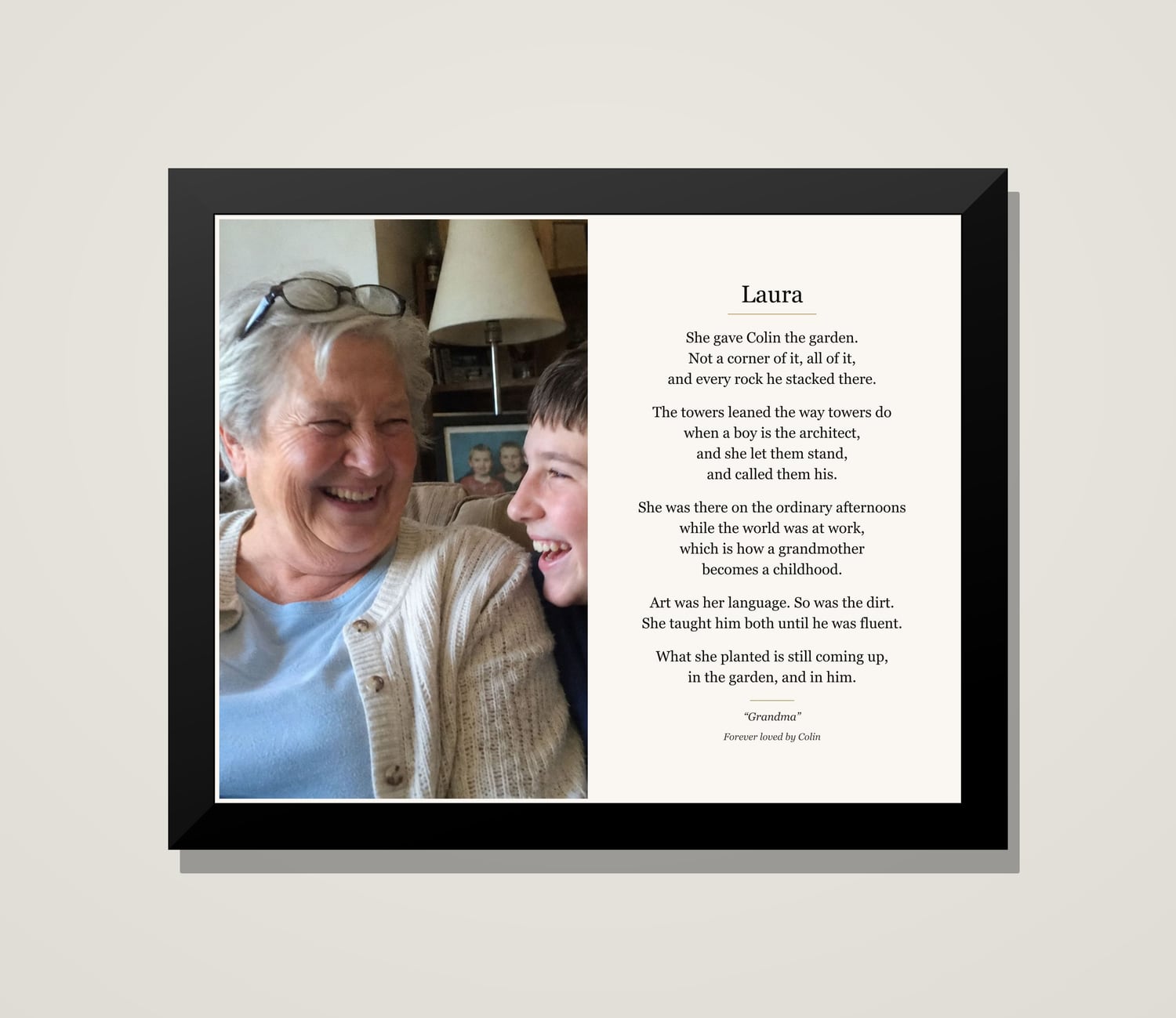
An original tribute to her, written from what you shared. Third person by default, or a letter if you’d rather. It’s typeset beside her photograph on cream paper, printed as a giclée on archival stock, set in a gallery frame and shipped ready to hang.

None of that happens before you have seen it. You get the complete piece exactly as it will print, every word and the layout and the photograph, and you can change a line, ask for a different take, or sit with it for a week. You pay when you approve it and not before. On a gift that matters more than usual, because you know the family and you’re the right judge of whether a word sounds like theirs.

It ships gift-ready, with a note card printed on the same cream paper and signed from you. Nothing in the box reads like it came from a company. The full process and timelines covers what happens after you approve.

Sizes and prices

  • Framed 8×10″, $79. Chosen most often when siblings want one for each house, or when it will live on a shelf rather than a wall.
  • Framed 11×14″, $119. The common choice for a mother, and the size that reads clearly from across a family room.
  • Framed 16×20″, $169. For a hallway or a stair wall, where it gets passed several times a day.
  • Framed 20×30″, $249. Gallery scale, for the wall everybody sees at Christmas.
  • Print only, 11×14″, $39. The same archival print without the frame, useful when other people in the family want their own copy of the writing.
  • Digital keepsake, $19.95. A printable high-resolution file of her tribute.

US shipping is free on every order. If you’re unsure which size suits the house it’s going to, write to [email protected] and someone at Known Truly will think it through with you.

Begin with one thing you remember about her

A photograph and a few details are enough to start. You approve the finished piece before you pay.

Begin her tribute